
Labor Day 2025: Three Attacks on the Working Class, One Way Forward
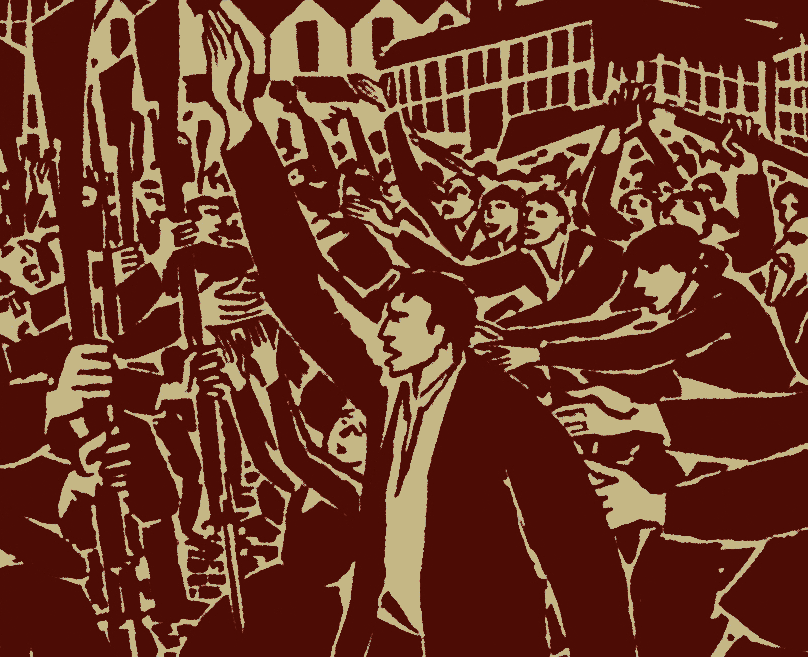
The time since last year’s Labor Day has shown that capitalism continues down its death march. This year, Klasbatalo and the Internationalist Workers Group reflect on three attacks launched by the bosses in the last 12 months and prospects for workers in Canada and the US. None of these attacks have emerged out of the ether - they are the convulsions of a dying system. Although the situation may seem dire, anti-deportation protests, refusals, and the inevitability of more strikes to come emphasize the need to keep fighting, and for a concrete political orientation to guide the class forward.
The Capitalist State vs. The Workers
The first attack is the unprecedented legal machinery developed by capital in the past year. In Canada, we have seen strikes, led by unions and ultimately dead-ended, which included port workers on both sides of the continent, in addition to rail and postal workers. These rattled beleaguered supply chains, and therefore drew the ire of the bosses in the headlines as being particularly ‘selfish’. Unlike most strikes which tend to result in meager settlements, forms of ‘negotiating down’ through union arbitration, the Labour Minister was set in to force arbitration. What makes this unusual is that the bosses are historically content to let unions have their slice of the pie in exchange for pacifying workers. These attacks on the Canadian working class form a blueprint for capitalists across the world, not least in the United States. For instance, the Trump administration has unleashed a salvo of attacks at workers in the same vein. Although less socially liberal than Prime Minister Carney, Trump’s actions are signs of converging interests by the capitalists to increase attacks on workers. There are the famous cuts headed by his (former) cheerleader, Musk, resulting in thousands of federal layoffs. In addition, Trump has reconstituted the National Labor Relations Board leadership in a long-term bid to make striking more perilous and to give the bosses more power. Even though the primary targets are unions, the knock-on effects include greater scrutiny against any form of labour action, including banning the use of work emails for labour organizing. This is in addition to various cuts against hazard pay, a promise to freeze the minimum wage through executive order, as well as the degradation of at-home careworker minimum pay. Combined with the Big Beautiful Bill, which hacks at welfare like a butcher’s knife, the message is clear; American workers pay tribute to their masters, while unions incompetently fight to defend their own turf in protracted legal battles ‘for workers’. The effect is the impoverishment and disorientation of the whole class, with reindustrialization being the sweet promise of more gruelling work. In the US, as in Canada, Carney and Trump agree to crack the whip.
From this, we highlight two important lessons. The first is the reality that unions are part of the capitalist state and will fold under pressure. This lesson alone is something that has been known for over a century since the unions agreed to ‘no strike’ clauses in the service of nationalism. The second is that the capitalist state is escalating their policing of the class as part of a general crackdown in preparation for war. This is the real push behind Bill 89 in Quebec, which enables the provincial government to leverage the ‘public good ‘in ruling a strike illegal. So long as such attacks stay on the terrain of union legal battles, the working class will sustain loss after loss. Insofar as further strikes continue popping up, workers need to be ready for this ‘new normal’, and must fight against the preparation for war and the legal means enabling it. In doing so, workers need a concrete political orientation beyond immediate defences and economic disputes. This is why the historical objective remains the abolition of capital, spearheaded by an internationalist party of the working class. It is the pursuit of this goal that alone can lead to real leverage from the workers against capitalists. This can never be achieved if workers on the picket hold onto the illusion that unions and the capitalist state can substitute for real class struggle.
Immigration and the Working Class fightback
The second major attack is on immigrant workers. In Canada, the US, and around the world, brutal attacks against migrant workers have multiplied. Carney's Liberal government has continued Trudeau’s policies to reduce immigration after inviting millions during Covid to resuscitate declining capitalist profits. It is little wonder that the United Nations have since condemned migrant workers' treatment in Canada as being analogous to slavery. In the US, ICE and the DHS’ raids have continuously been used to strike fear in migrant workers who already have no protections. In addition, we have seen an unprecedented crackdown on international students. In the US, these attacks preceded Trump's administration, such as in the targeting of Chinese students and condemning them as national security threats, setting the precedent for revoking student visas for participating in Gaza protests. Not confined to the Trump administration, Canada has also reduced the amount of international students by 48%, under particular pressure in some provinces such as Quebec, who see them as visa “freeloaders.” These attacks have been bipartisan and are dressed up as defending national interest and democracy. Bosses everywhere have become more bold in their attacks, with growing xenophobia accompanying the war narrative. Imperialist capitalism threatens the entire world to ride off the rails, as mass slaughter becomes the only remaining solution for a weary capitalist class.
Growing repression against migrant workers and students has to be opposed by the working class as a whole, for the working class. An attack on a foreigner is an attack on a native; it all serves to discipline an already heavily-exploited working class for war. It is therefore encouraging that workers in the US showed great courage and a burgeoning sense of class consciousness by organizing neighborhood and workplace group chats to warn and mobilize against attempted deportations and to set up demonstrations. In addition, workers in the heavily-targeted hospitality industry had strikes which put forward political demands to stop the brutal raids. However, lacking a concrete political orientation, this self-defence can only go so far. Like the attacks on recent strikes, the surge of action by the class remains disorientated and fragmented, showing a need to grow the flame into real proletarian power. This state of shakiness is how workers' actions are being crushed with the full brutality of the much hated Los Angeles police department and county sheriffs, stifling their combativity. The real defense is an organisational offensive.
When trade wars turn to generalized wars
The third attack is the ongoing march towards generalized war. Trump’s administration has led to a total upheaval of the liberal order, and has consequently sharpened tensions between allies and rivals alike. At the NATO summit in Kananaskis, fault lines within the imperialist bloc comprising the two North American member states ruptured further. On the one side, the American bourgeoisie is reconsidering their efforts to underwrite the treaty. On the other, the Canadian bourgeoisie still identifies their interests in maintaining their position in this postwar order. Where Trump seeks to compel wider rearmament with the threat of withdrawal, Canada seeks to present itself as a reliable resource pool to European capital with a shared interest in mutual defense, amounting in all cases to a call to rearmament that foreshadows the slaughter of the working class. As defense budgets soar in America to absorb superfluous productive capacity in the form of armored vehicles that Pentagon officials insist they have no use for, Canadian defense contractors answer calls from Europe to join military development projects in arrangements never dreamed of in feverish pulp novels.
Between Trump’s blustering over the annexation of Canada and the Canadian call (alongside Europe) to recognize a Palestinian state, the U.S.-Canadian partnership is being battered. ‘Anti-imperialists’ of all varieties; Stalinist, Trotskyist, etc. may mistakenly see this divergence as some potential wedge in major capitalist nations to exploit in favour of their preferred nationalism’. In truth, there is no permanent peace, no ‘just wars’, no righteous nationalisms, because imperialism is a feature of capitalism, not of individual states. Take the war in Gaza for instance. While Hamas has bit off more than it can chew from its assault on October 7th, the famine in the Gaza strip is not the outgrowth of Israel as a uniquely illiberal nation, but an example of what capitalists are capable of. This is why the Israeli stock exchange is booming even as war fatigue sets in. The short term ‘heat’ is worth the long term gains from rebuilding the wasteland Netanyahu has created, while keeping his domestic and foreign adversaries busy. While ‘liberal’ leaders such as Carney, Starmer, and Macron may call out the worst excesses of Netanyahu’s genocidal campaign, it is primarily a vehicle for leverage against a ‘bad’ United States administration. In addition, the Palestinian Authority is more than eager to become this new leader of a Palestinian state, an opportunity which can only be exploited under the abject conditions in the Gaza strip. Even if a ceasefire were to be hacked out overnight, the structural incentives for conflict remain, as they are rooted in competition between nation states, that is, national capitals. Meanwhile, Trump’s yo-yo negotiations with Russia highlight that the war in Ukraine will continue for as long as it needs to, determined principally by the utility it has for Russian and Ukrainian capitalists, with both having irredentist demands that can never be satisfied outside of total attrition. Even the ‘historic’ deal between Armenia and Azerbaijan guarantees that the latter will become a US staging ground for further attacks into Iran, and that the former is to collapse to civil war under greater calls for ethnic revanchism, fuelled by Russian support to regain its Caucasian foothold. No matter the situation, capitalists all converge on one objective; wars will be waged no matter what.
The one way forward
It is clear that the capitalist order is on a sinister path. The working class is assaulted directly and indirectly through the crushing of wages and various forms of welfare, social guarantees, etc. It signals the trajectory of the capitalist class as whole - the workers must be ready to accept sacrifices now and be made to toe the line so that when the day comes, they will march to the front. Immigrant workers are the first to be deported and detained en masse to tighten the pool of workers and to guarantee precarity for profits. However, far from falling to pessimism or delusion, the working class remains the only one poised to fight these myriad evils. The protests and riots in LA demonstrated that the class can summon inordinate combativity. That will to fight presents an opportunity unlike any other, though it must be channeled into a concrete political direction through the formation of a party. In addition, mounting refusals from workers in Russia, Ukraine, Israel, Gaza, etc. to fight for imperialist slaughter demonstrates that the more capitalists push, the more workers push back. Far from archaic, the examples of the Kiel and Petrograd sailors' mutinies show that even the greatest wars can be ground to a halt by the efforts of devoted militants. To succeed, workers cannot hold onto the illusion that unions or nations can come to their salvation. These are not weapons or contingencies, but rust upon the real sword of the working class; self-organization. Workers must organize outside of unions, across borders, and against war, wherever possible, to refuse the sacrifices demanded of them. When workers struggle on the basis of their own strength, whether through strike committees, mass assemblies, or even workers’ councils, their fight becomes political. The capitalist hydra has been struck once in the past, in the example set by the Russian Revolution, but the heroic task was stifled, as in the epics, with the capitalists growing back the limbs they had once lost. It is for this reason that the future party of the working class must form and strike boldly through the heart of the beast.
KB and the IWGLabor Day 2025

Start here...
- Navigating the Basics
- Platform
- For Communism
- Introduction to Our History
- CWO Social Media
- IWG Social Media
- Klasbatalo Social Media
- Italian Communist Left
- Russian Communist Left
The Internationalist Communist Tendency consists of (unsurprisingly!) not-for-profit organisations. We have no so-called “professional revolutionaries”, nor paid officials. Our sole funding comes from the subscriptions and donations of members and supporters. Anyone wishing to donate can now do so safely using the Paypal buttons below.
ICT publications are not copyrighted and we only ask that those who reproduce them acknowledge the original source (author and website leftcom.org). Purchasing any of the publications listed (see catalogue) can be done in two ways:
- By emailing us at uk@leftcom.org, us@leftcom.org or ca@leftcom.org and asking for our banking details
- By donating the cost of the publications required via Paypal using the “Donate” buttons
- By cheque made out to "Prometheus Publications" and sending it to the following address: CWO, BM CWO, London, WC1N 3XX
The CWO also offers subscriptions to Revolutionary Perspectives (3 issues) and Aurora (at least 4 issues):
- UK £15 (€18)
- Europe £20 (€24)
- World £25 (€30, $30)
Take out a supporter’s sub by adding £10 (€12) to each sum. This will give you priority mailings of Aurora and other free pamphlets as they are produced.
ICT sections
User login

This work is licensed under a Creative Commons Attribution 3.0 Unported License.