
15 October was the first global event (spread over 90 countries) against the effects of the crisis.
The events were notable everywhere for their peaceful and inter-class character. These two features broadly represent the major limitations of this "movement". Pacifism is a limitation for us not because the demonstrations - in general demonstrations of struggle and protest - should express themselves in mindless violence, but because "non-violence" is an ideology that excludes _a priori_ real forms of class conflict, which may sometimes also take "violent" forms, in particular as a reaction to bourgeois repression, as well, of course, as having the effect of excluding revolutionary activity itself. Interclassism means not recognising the division of society into classes, in fact to deny the working mechanism of capitalism - based on the exploitation of the proletariat by the bourgeois class - not to recognise the centrality of the proletariat, without whose action there will never be a real social conflict and even less chance of a transformation of society.
Music, drums, group meditations, festivities, etc... On top of the characteristic of non-violence, the interclassist and neo-reformist slogans (we won’t pay their debts, real democracy, etc...), confirmed to us that the ball of movement of indignation is in the hands of petty bourgeois humanist ideology. When the proletariat is present it is fragmented and dispersed, it does not express its social identity, much less its own political identity.
The fact that opposition to the crisis manifests itself in encampments in squares, demonstrations characterised by pacifist non-violent ideology - in two words, petty bourgeois - goes hand in hand with the low level of struggle in the workplace and in communities. Ideological schemes dominate, when the real problem is how to effectively counter the vicious attacks of capital.
In any case, the success - in terms of numbers - of the events of 15 October, especially in Italy, is a clear signal that the crisis is eroding the living and working conditions of ever wider masses of the proletariat and even masses of non-proletarians. This social anger was expressed even in Rome, but in forms that are not going to affect in any way the economic and political domination of the bourgeoisie. The indignant ones and the so-called "anarcho-insurrectionaries" in Rome were two safety valves for this anger, but neither of them leads to the real social conflict, which must be expressed primarily in the workplace. The conflict in the workplace, in general the opposition between bosses and workers, is the real barometer of social struggle, a struggle which then inevitably spills into the squares, onto the streets. This is what, for example, has happened in Greece, where the conflict between labour and capital is also being fought in the workplace, with strikes, often wildcat and uncontrolled ones, and consequently where the "street violence" has taken on social significance very different from what went on in Rome. In Italy the thermometer of social conflict is at a very low temperature and the episodes in Rome are not yet a direct expression of conflict in the workplace.
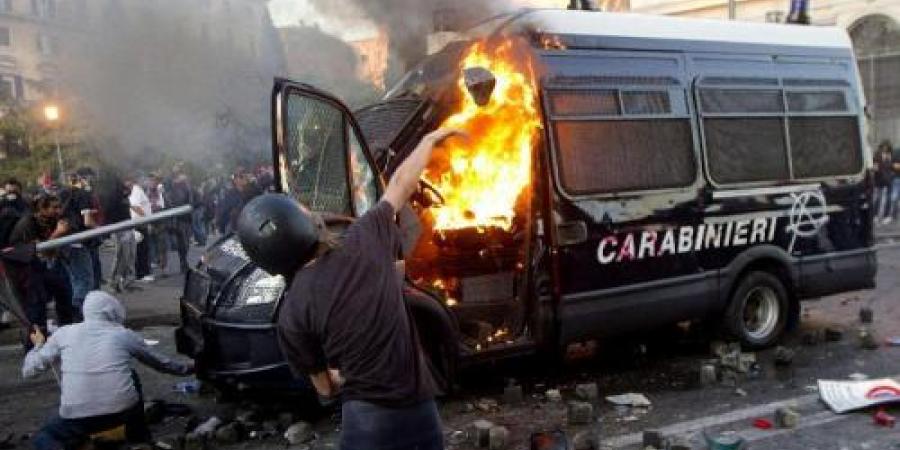
The violent events which took place in Rome saw the coexistence of different factors, including:
* The increasing presence of possible provocations from institutional sources or those close to them, such as, for instance, neo-fascist ultras that may have infiltrated the demonstration to promote a particular plan - as the '70s and Cossiga taught us - the breaking-up of the event, thus providing justifications for violent intervention by the police. The latter did not hesitate to charge the protesters with trucks carrying water cannons. However, even before this, they began to break up the demonstration by attacking the biggest sections, thus carrying out a more violent and widespread crackdown against the main demonstration than against the guerrilla actions and the young people who joined it; a repression which carried on the next day.
* Then there were the elements which the bourgeois means of disinformation define as "anarcho-insurrectionist". They are distinguished by their insurrectionary project, by actions against the symbols of bourgeois power (banks, employment agencies, law enforcement, etc. ). Clearly this ideology wants to voice the anger and distress experienced by large sectors of the population, especially the working class, channelling it towards extreme practices (propaganda by the deed, and the aim of generalising the revolt as a political proposal in itself). Obviously, this ideology lacks a revolutionary programme, denies the centrality of the conflict (class struggle) in the workplace and in the community through the growth of proletarian organisation. In fact, for this reason, even though we may generally share the concerns that motivate them, the praxis related to this ideology is not feasible nor is it a useful perspective for the working class.
* Finally, there were a large number of participants in the demonstration, mainly working class, who reacted spontaneously and with a real sense of anger towards the arrogance of the bourgeois forces that charged the protesters.
In short, it is a complex picture which should be seen as a whole, without falling into a black or white judgements.
In all probability, the demonstrations will increasingly have to face up to similar dynamics. The crisis brings cuts in wages and what remains of the "welfare state", layoffs, even worse job insecurity, etc.. This creates a growing frustration among the affected sectors, particularly among young workers who do not have a job and when they do, they are subjected to the blackmail of insecurity, which prevents them from participating even in the most innnocuous strikes (from the bourgeois point of view) organised by the unions. The demonstrations are one expression of this frustration. What we saw in Rome and in 2001 in Genoa is the pattern by which the bourgeoisie will handle potentially explosive situations of discontent (the goal of thousands of people camped out, if it had taken place, would have been an innovative factor towards a practical and effective critique of traditional mechanisms for controlling the streets, thus undermining them).
The dominant ideology is basically divided into three different readings of what happened:
1. The crass Right that says "there are no differences among the demonstrators, they are all criminals, arrest them all, we need special laws". To no-one’s surprise, Di Pietro has gone beyond the right, dusting off the draconian Reale Law (1).
2. The right-wing liberal (Draghi), the left part of the liberal and reformist left, which state that the demonstration was peaceful and festive, positive, until violent 'hoodies " ruined the party (as if there was something to celebrate!). This vision is already creating the foundation for solidarity between good demonstrators and security forces and, therefore, for the preparation of a mass consensus for repression in the future: if you make the demonstrations festive and peaceful, the police are okay with you, if you express radical content, undertake more than just empty actions (occupations, blockades, wildcat strikes and so on) to express your anger you are bad and should be repressed.
3. The radical institutional reformism (editorial article by Valentino Parlato and Loris Campetti on the _Il Manifesto on Sunday_) who argue that these socio-economic clashes "were inevitable” and take this expression of anger back to their project for "a renewal of politics". For them it "is a positive challenge to the current leftist parties to leave the past behind and take note of how the world has changed" and therefore "there must be changes also in the struggles at work and in the union, and in economic policy."
Absent, naturally, from these visions is the viewpoint of the proletariat, which can be summarised in three demands:
1. the need to develop resistance to capital’s attacks outside and against union logic and to start from self-organisation of the struggle in communities and in the workplaces;
2. the need for the working class sections of the demonstrations to be able to provide self-defence against the police, and infiltrators pursuing a different, rather confused political project (albeit for understandable reasons) from a class perspective, but without falling into the strategic error of confusing bourgeois violence (which is practised in demonstrations, but even more extensively in our everyday life) with the rage of those who follow a mistaken and bankrupt political path;
3. the absolute need to give strength and substance to a revolutionary leadership that knows how to channel the more than legitimate social anger into a coherent anti-capitalist struggle.
Finally, the State largely comes out of the Rome demonstrationas the biggest winner. Not only has it shown a great ability to control the street as it likes, but it also achieved significant results. First - and it is a fact not to be underestimated - in this way the indignados project to camp in the Piazza San Giovanni failed. The movement of indignados has huge limits, but it at least - though in a very confused way - carries out a critique of political parties and trade unions. A camp of a limited movement, but which really wants to be "non-partisan," which in some cases calls into question the institutions themselves, would certainly not suit the State. Just remember what happened in Spain, where the indignados - and there was no black bloc there - were driven from the square with violence.
(1) Passed in 1975 at the time of the Red Brigades (named after the Minister responsible Oronzo Reale) it is a draconian law against any form of public protest, Antonio Di Pietro is well-known as the chief magistrate in the “mani pulite” (clean hands) investigations against the “tangentipoli” (bribesville) scandals involving politicians and business which brought down the First Italian Republic in the 1990s. Berlusconi was deeply involved - his media empire was bankrolling the Socialist Party of Bettino Craxi - until Craxi fled to Tunisia. Berlusconi entered politics at this time (1994) to ensure that the judicial system would not investigate him further. The comment here is intended to be ironic as Di Pietro, a constant opponent of Berlusconi, is supposed to be a liberal.