
May Day, Spring 2024

I hope this place can continue with the type of contributions on the libcom-thread "forgotten great theoreticians" (created 13 years ago). Fora are a good means I think to share such info, but I will still try to stay brief.
Volodymyr Jurinetz (1890–1937), probably the greatest Ukrainian Marxist theorist.
As to the Ukrainian national question, he took position against both what he called Ukrainian chauvinism and Russian chauvinism (in the communist camp). Jurinetz disagreed for example with (the left-oppositionist) Vaganian's 1927 book On National Culture (is online), because Vaganian had argued that the "concepts of national culture and socialist culture are mutually exclusive". Later Jurinetz was repressed with one of the reasons, if I recall, being his alleged soft spot for Ukrainian nationalism. Again, Jurinetz did also criticise Ukrainian nationalists, eg Dmytro Dontsov in a 1926 article titled "New ideological Manifesto of Ukrainian Fascism" (is online, in Ukrainian).
I posted a biographical note on Jurinetz, and a short translated text at tapatalk.com
Anyway. Jurinetz' student, Petr Demchuk was also a good scholarly Marxist (in philosophy, maybe second in Ukraine, after Jurinetz).
Lev Vasilevsky (1876–1936), medical doctor, who in the 1920s wrote many booklets in the Soviet Union on health issues, some that are highly-political today; abortion, prostitution, sex education, women's health, drugs, nutrition, child delinquency, and so on. I refer to some of these works here (plus a short translation of his review of Sinclair's The Jungle) at academia.edu
Now Vasilevsky was a socialist, but (afaic tell from eg his 1907 book Liberalism and Socialism) he was not a fully orthodox Marxist. That probably is irrelevant to the objectivity of his analyses in his specifalised field, eg his works on occupational health hazards. He also wrote a booklet examining the relation of chess (the game) and health. He was also a poet and theatre critic. But so I draw attention to him here especially for his booklets on the topics, that are (nowoadays) politically sensitive or obsessional, and for which I believe a socialist independent voice is needed.
Boris Roniger (1896, Odessa – England post-WWII, exact date unknown), was a rare leftcom Luxemburgist (adherent to her economic theory). I posted much info on Roniger (also spelled Roninger) on the old ICC forum (now closed web.archive.org), asking researchers to help find more of his works. I won't repeat everything here. His big book on Trustkapitalismus was scheduled to appear in the same series as Henryk Grossman's and Fritz Sternberg's, but probably due to coming to power of the Nazis it only remained as an unpublished manuscript (we need to find it's location today).
He tried to go America (enlisting the help of Einstein for a grant) without success, so fled to Switzerland, where he probably learned about Swiss liberal theology, eg that of the famous Karl Barth, or Fritz Lieb, a Slavist theologian, who in early 1920s had been sympathetic to communism. After WWII Roniger became professor in Oxford, apparently in theology (eg a lecture on "Karl Barth's Philosophy of Religion”, Oriel College), but he still was leftwing. Maybe Roninger was still alive when the CWO was formed...
The Internationalist Communist Tendency consists of (unsurprisingly!) not-for-profit organisations. We have no so-called “professional revolutionaries”, nor paid officials. Our sole funding comes from the subscriptions and donations of members and supporters. Anyone wishing to donate can now do so safely using the Paypal buttons below.
ICT publications are not copyrighted and we only ask that those who reproduce them acknowledge the original source (author and website leftcom.org). Purchasing any of the publications listed (see catalogue) can be done in two ways:
The CWO also offers subscriptions to Revolutionary Perspectives (3 issues) and Aurora (at least 4 issues):
Take out a supporter’s sub by adding £10 (€12) to each sum. This will give you priority mailings of Aurora and other free pamphlets as they are produced.
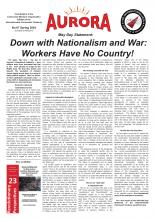
May 2024
Aurora is the broadsheet of the ICT for the interventions amongst the working class. It is published and distributed in several countries and languages. So far it has been distributed in UK, France, Italy, Canada, USA, Colombia.

March 2024
Mutiny is the bulletin of Klasbatalo. Mutinerie est le bulletin de Klasbatalo.
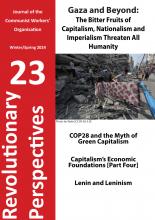
Out now!
Journal of the Communist Workers’ Organisation -- Why not subscribe to get the articles whilst they are still current and help the struggle for a society free from exploitation, war and misery? Joint subscriptions to Revolutionary Perspectives (3 issues) and Aurora (our agitational bulletin - 4 issues) are £15 in the UK, €24 in Europe and $30 in the rest of the World.
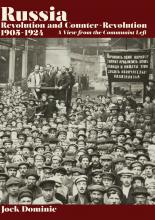
Written by Jock Dominie. £12, 276pp.
The Russian Revolution remains a landmark event in history. For the bourgeois historians, the October Revolution is thought to be a tragedy that set back the achievements of the “democratic” February Revolution, and allowed the Bolsheviks to wreak havoc on their citizens and the world. For the Stalinists, the events of 1917 paved the way for the birth of the USSR, which they point to as a prototypical example of “socialism in one country”. In reality, the February and October Revolutions were both part of the same proletarian revolution.
The book can be ordered by emailing us at uk@leftcom.org and asking for our banking details, or by donating the cost of the publications required via Paypal using the “Donate” button. Postage charges should be added. If in the UK, and paying direct to our bank account, first class postage is free. If via Paypal add £2. For Europe cost of a copy with postage is €20 (EUR), for Australia it is $42 (AUD) and for the USA and anywhere else in the world it is $27 (USD).

This work is licensed under a Creative Commons Attribution 3.0 Unported License.

On a previous thread on this
On a previous thread on this forum I already mentioned the theorist Isaak Dashkovskij: leftcom.org
You might also remember his article on abstract labour (criticising Isaak Rubin), which the riff-raff comrades translated into Swedish and distributed (thanks!): riff-raff.se
For the sake of posterity, I will list here Dashkovsky's writings in the Kharkov-based Хозяйство Украины (Economy of Ukraine, or in Ukrainian: Господарство України 1924-34, index for 1924-29 online). Issues 1929-34 are online here, but not the relevant early years. Notably, these early years include Dashkovsky's review of Keynes' book A Tract on Monetary Reform (namely in issue 1924, no. 1, pp. 164–69). Further, Dashkovsky's reviews of:
On p. 35 of the index you can see also listed some general theoretical articles on conjucture (/crises):
Unfortunately the early years of this journal (1924-1928) are impossible to find (even in Ukraine). I discovered that Geneva's ILO library (and a few other Western libaries) do hold a journal with the same title and even the same running-date, but the sub-title is different (and I received a page-scan, which proved that it's not the same journal). I assume that the site which put the issues online from 1929-34 (when the journal changed its title into Ukrainian) must just honestly not possess the issues from 1924-28.
Speaking of Marxist receptions of Keynes, it is appropiate to mention the essays by Jürgen Kuczynski in his 1937 booklet New Fashions in Wage Theory (which attacks Keynes and others, like Robinson and Hicks), because despite the fact that Kuczynski was a celebrated theorist (probably the foremost Marxist in GDR), – and rightly so based on the extensive body of his "empirical"-historical research, – he remains relatively unknown to the current Anglophone audience (including academics). This 1937 book should really be made freely available online, as it's relevant to the inflation debate issue (on archive.org you can only check the preview freely). To be clear, the book is in English (and only English).
I posted the table of contents of Kuczynsky's 1926 book Zurück zu Marx! Antikritische Studien zur Theorie des Marxismus [Back to Marx! Essays of Anti-Critique on the Theory of Marxism] here: tapatalk.com
I feel like I forgot one other theorist that I wanted to mention.
Tadeos Avdalbegjan (1885–1937
Tadeos Avdalbegjan (1885–1937) was an Armenian Marxist. Translated Marx's Capital into Armenian.
A significant space is devoted to republication of Avdalbegjan's Marxist writings in a 2011 Russian edition of Capital Volume 2 ("Критика политической экономии. Том II" Клюкин), see pp. 1003–1169. This is because of Avdalbegjan's theoretical contribution on the schemes for simple and expanded reproduction (2 works in Russian, published in 1930, and 1931 Yerevan pp. 113). He also wrote an article on gold in the scheme of simple reproduction (1929) which sparked a series of polemics (with Vladimir Poznjakov). The 2011 addendum interestingly contains furthermore eg his (unpublished) book review of Luxemburg's Accumulation book (pp. 1159–1166, no date).
I found also a 1932 article titled "An expanded schematic table of simple reproduction of a socialist economy".
From Wikipedia:
"The author of several Russian-Armenian dictionaries, he introduced about 30 thousand new terms into the Armenian language. Translator of economic literature, including the works of Lenin, Rosa Luxemburg, Franz Mehring and Karl Marx (performed a complete translation of Capital into Armenian). Author of numerous works on the history of Armenia from the 5th to the 19th centuries. He proposed schemes for simple and expanded reproduction in the economy.
... along with Ashot Ioannisyan, Tadeos Avdalbegyan belonged to that Marxist revolutionary intelligentsia of Armenia who, during the years of Stalinism , were either exiled or executed, and in modern Armenia 'are subject to fierce, almost manic criticism from nationalist Armenian scientists' creating a national ideology."